

Discover five evidence-based provocations to unlock pricing power for your brand
For years, your marketing department was the subject of light-hearted office banter, but now the evidence has turned laughter into respect. Once seen as a cost center, the marketing team is now recognised for its significant impact on your business's financial success.
How did you achieve this? The answer rests in pricing. You decided to make it a top focus and then oriented your team toward this mission by giving them five evidence-based provocations to live by. They are, as follows.
| 01 | Have a good grip on Pricing Power
What is Pricing Power and why does it matter?
The concept of price elasticity comes from a simple empirical truth: when brands raise prices, unit sales drop. Now, here's the nuance: for any given price range, different brands will see different volume drops.
Stronger brands have greater Pricing Power which grants them lower price elasticity. They lose less volume and make more margin for their businesses when they raise their prices.
KEY FINDING: Stronger brands have greater Pricing Power, which grants them lower price elasticity. They lose less volume and make more margin when they raise prices.
The correlation between Pricing Power and price elasticity is firmly validated. Why, then, do CEOs and their boards devote so little attention to brand health? Because human instinct favours that which moves fast and overlooks what moves slowly. Pricing Power is a slow-moving metric. It reflects long-term, gradual shifts in consumer attitudes. Marketers are often under pressure to show immediate unit volume growth; they can't always wait around for Pricing Power. Some even omit it altogether from their KPIs. Your team won't make that mistake.
| 02 | Know what you are worth, then ask for it
How do you know if your brand's price matches its perceived value?
When economic conditions worsen, people don't necessarily switch to the cheapest brands. Instead, they turn towards value, specifically, towards the products or services whose price matches the value on offer. A brand is a promise to consumers. In tough times, good marketers make sure that the value promise they're making to consumers is compelling and true.
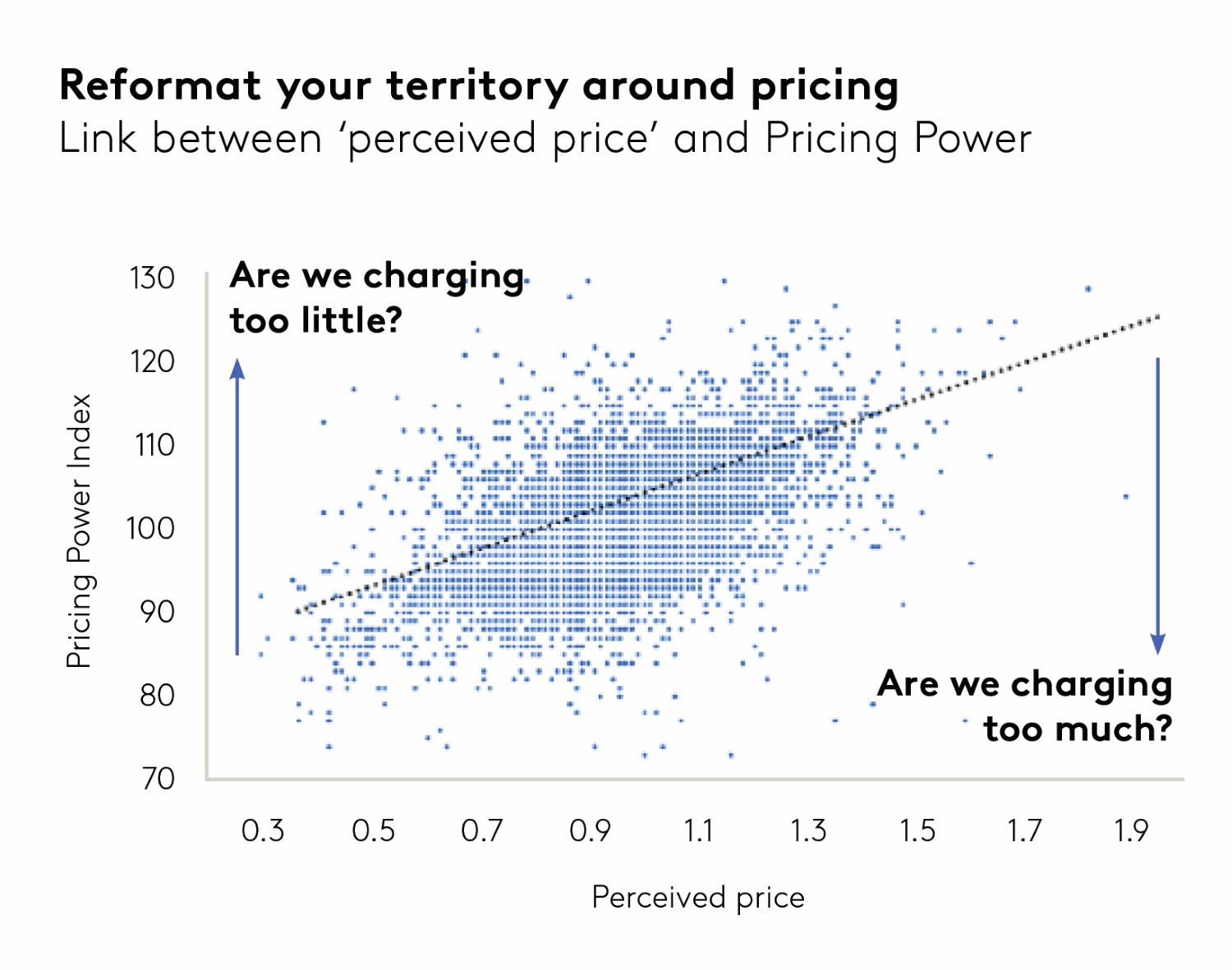
To find out whether your value matches your price, you can cross-plot 'perceived price' (relative to category) versus 'Pricing Power'. Across that dotted line, there is harmony between the two - consumers see you as being priced at a level that corresponds to the amount they're willing to pay for you.
If there's a mismatch, in what direction does it lie? If your brand is above the line, it means your brand is seen as costing less than most people are willing to pay for you. That gives you leeway to increase prices and reduce discounts, if needed. And if you're below the line? You're seen as being too high-priced of a brand for what you provide. To fix this, you could cut prices and accept a reduced margin.
| 03 | Put emphasis on brand perceptions, not price
How do brand perceptions reduce price sensitivity?
Your brand may not be functionally different from competitors, but if it feels different, consumers will value it more than the alternatives. Brand perceptions matter. Kantar research has repeatedly shown that Different perceptions are the best way to desensitize people to price increases. How? When people see your brand as relatively Different to others, they are less likely to see competitors as possible substitutes.
But how much exactly is a tiny change in perception worth? We mapped the brand equity of thousands of brands in our Kantar BrandZ Global database against their current price, and discovered two important dynamics:
KEY FINDING: A one-point gain in Pricing Power can justify a four-point increase in relative price.
KEY FINDING: Brands with high Pricing Power can charge up to twice as much as those with low Pricing Power.
Have you reviewed and updated your brand's strategic positioning recently? Committing to what your brand should stand for - and deciding what perceptions you want to reinforce or shed - is a great way to nourish your brand.
| 04 | Be wise to the pitfall of promotions
Why do promotions hurt long-term pricing power?
How many times have you caught yourself refraining from buying your favorite product, only because you knew it would soon be on promotion? Training your customers to follow extrinsic price cues can be an insidious thing for a brand, with no positive, long-term effect on sales.
In a recent McKinsey report on 'The Hidden Power of Pricing', researchers found that to offset a 5% price cut, volume sales must increase by 18%. Couple this with our data proving that volume-based deals have fallen out of favour and you'd think that sales promotions would be on their way out. But in fact they remain a hit with UK FMCG marketers, with sales on promotion recently rebounding to their previous highs of 30%.
KEY FINDING: To offset a 5% price cut, volume sales must increase by 18% (McKinsey, 'The Hidden Power of Pricing').
KEY FINDING: UK FMCG sales on promotion have rebounded to their previous highs of 30%.
This is a great place for your brand to buck the trends. Don't be swept away by the promotions tide: use them sparingly and strategically, always managing them against an objective.
| 05 | Favor the ads that decrease price sensitivity
Which types of advertising protect pricing margins?
It's always exciting to roll out a new campaign or product launch. But has your 'new news' succeeded in changing brand perceptions?
Not all campaigns have a positive impact on their business's stock price or bottom line. Those that stand out emphasize the functional, emotional and social value of a brand in consumers' lives. In the process, they also build brand perceptions that strengthen Pricing Power.
By analyzing hundreds of cases in the UK's Institute of Practitioners in Advertising (IPA) database, Les Binet and Peter Field demonstrated a correlation between very large brand-building effects and very large reductions in price sensitivity. We then overlaid Kantar data to conclude that emotional brand advertising particularly helps brands hold firm on pricing, thus protecting margins.
KEY FINDING: Emotional brand advertising particularly helps brands hold firm on pricing and protect margins (Kantar analysis of IPA data, building on Binet & Field).
Go on, measure your scraps and straws
Jeremy Bullmore famously said that, 'People build brands as birds build nests, from scraps and straws we chance upon.' What many don't know is that his later addendum states that some of these stimuli can, in fact, be measured. We concur.
Ultimately, every action your brand takes builds mental connections, not just with consumers, but with employees, investors, regulators and partners. Recognize this, and then get excited about the prospect of stimulating, reshaping and monitoring your chosen 'scraps and straws'. Do this well and your reward will be enhanced brand perceptions that deliver great financial benefits for your business.